


Is Your Home Working for You?
Your home should do more than hold your memories. It should support your future.
If there is one topic that remains surprisingly underdiscussed in retirement planning, it is housing. Think of everything it touches: our finances, proximity to loved ones and community, and our health, safety, and overall well-being. Yet many people give far more attention to their investment portfolios than to the place where their future will actually unfold.
That can be a costly oversight. The home and community that served us well in one stage of life may not serve us equally well in the next. When it comes to housing as we age, complacency and inertia are rarely our friends. The goal is not necessarily to move, but to remain intentional—regularly asking whether our current place still supports the life we want to lead.
A home is not just a financial asset or a collection of rooms. It is an environment that shapes what we do, whom we see, how active we are, what we spend, and how easily we can adapt when life changes. We don’t shape place; place shapes us.

Retirement Planning Should Include Place
That is why retirement planning must be about more than money.
A financial plan can help determine whether your resources will last. But it cannot, on its own, tell you whether your daily life will work. Retirement planning is incomplete without adequate consideration of place—the setting in which your health, relationships, purpose, and independence will either be supported or undermined.
A longer life does not mean one extended retirement chapter. It means more chapters, more transitions, and more moments when the place that once fit us may no longer support the life we are trying to lead.
The house where you raised children may feel empty once they leave. The suburb that made commuting easy may become isolating after you stop working. Stairs that never warranted a second thought may become a daily obstacle. Friends may move away. Healthcare needs may change. Property maintenance may consume more time, money, and energy than you want to give it.
None of this automatically means you should move. It means you should pay attention—and begin the conversation before a crisis forces the decision.
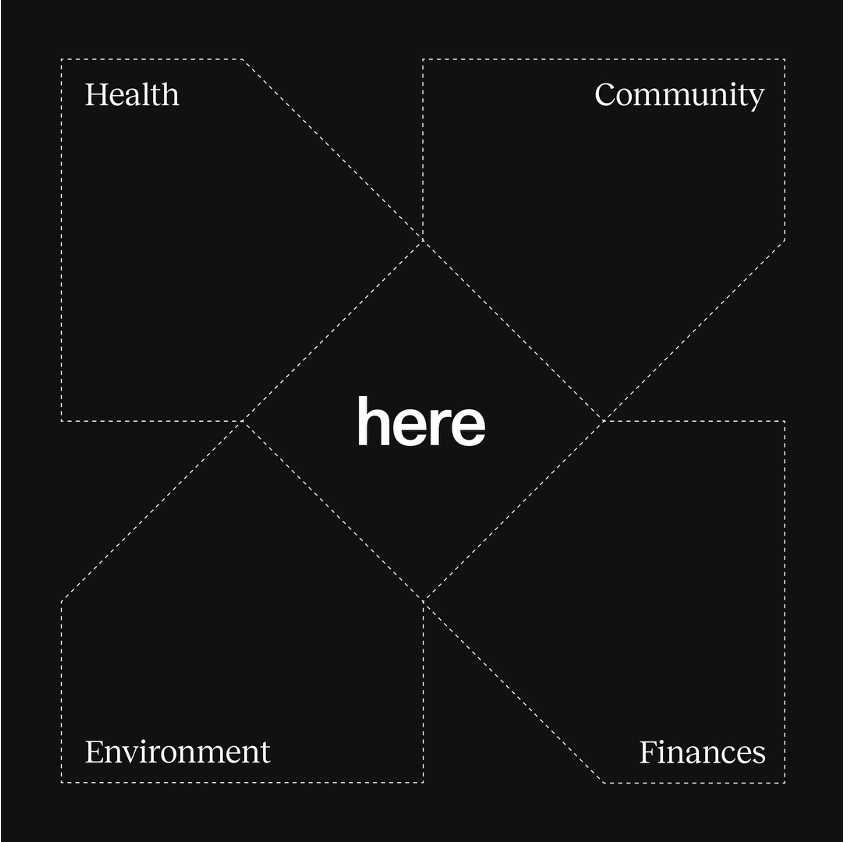
Environment, Health, Community & Finances
I think about place through the Four Quadrants of PlaceTM: environment, health, community, and finances.
The environmental dimension includes the home itself and the neighborhood around it. Does your space fit your current needs? Can you navigate it comfortably? Are the places you use regularly nearby? Does your community make it easy to get where you need to go?
Health includes more than access to doctors. Does your place make it easier to walk, eat well, sleep, spend time outside, and remain engaged? Healthy behavior is not simply a matter of willpower. Our surroundings either create tailwinds or headwinds for it.
Community may be the most overlooked dimension. Who would notice if you did not leave your house for several days? How often do you have meaningful contact with friends, neighbors, or family? A beautiful home can still be a poor place to live if it leaves you disconnected.
Then there are finances. Most homeowners know their mortgage payment and property taxes, but many underestimate the full cost of ownership: maintenance, insurance, repairs, utilities, and the opportunity cost of equity tied up in one property. Staying can be the best financial choice. Selling and renting can also be the best choice. The important thing is to compare the real alternatives rather than assume that owning indefinitely is always safest.
This is one reason place should be part of conversations with financial advisors and other trusted professionals. They can help model the financial implications of staying, moving, renting, renovating, or preparing for future care. But the larger question is not simply what you can afford. It is what kind of life each option makes possible.
A financially sustainable decision can still be a poor life decision.
Aging in Place Without a Plan is Not a Strategy
This is also why “aging in place” is not, by itself, a plan. It is a preference. A meaningful plan asks what must be true for staying to work. Can the home be modified? Is transportation available? Are relationships strong enough to prevent isolation? Can care be brought in if needed? Does the financial picture remain sustainable?
Aging in place can be an excellent strategy. Aging in place without a strategy is not.
The objective is not to find a universally perfect place. No such place exists. It is to identify the place that best supports who you are becoming.
That may mean moving. It may mean renovating. It may mean spending more time in another community before making a permanent decision. It may simply mean becoming more engaged with the people and resources already around you.
The important thing is to resist stasis. Place decisions made by default are still decisions, and over time they can narrow our options.
Look ahead five years. What might change in your health, work, family, friendships, or finances? What kind of ordinary Tuesday do you hope to have? Then ask whether your current place makes that life more likely.
Your portfolio can help fund your future. Your place will help determine how that future actually feels. A complete retirement plan should account for both.